
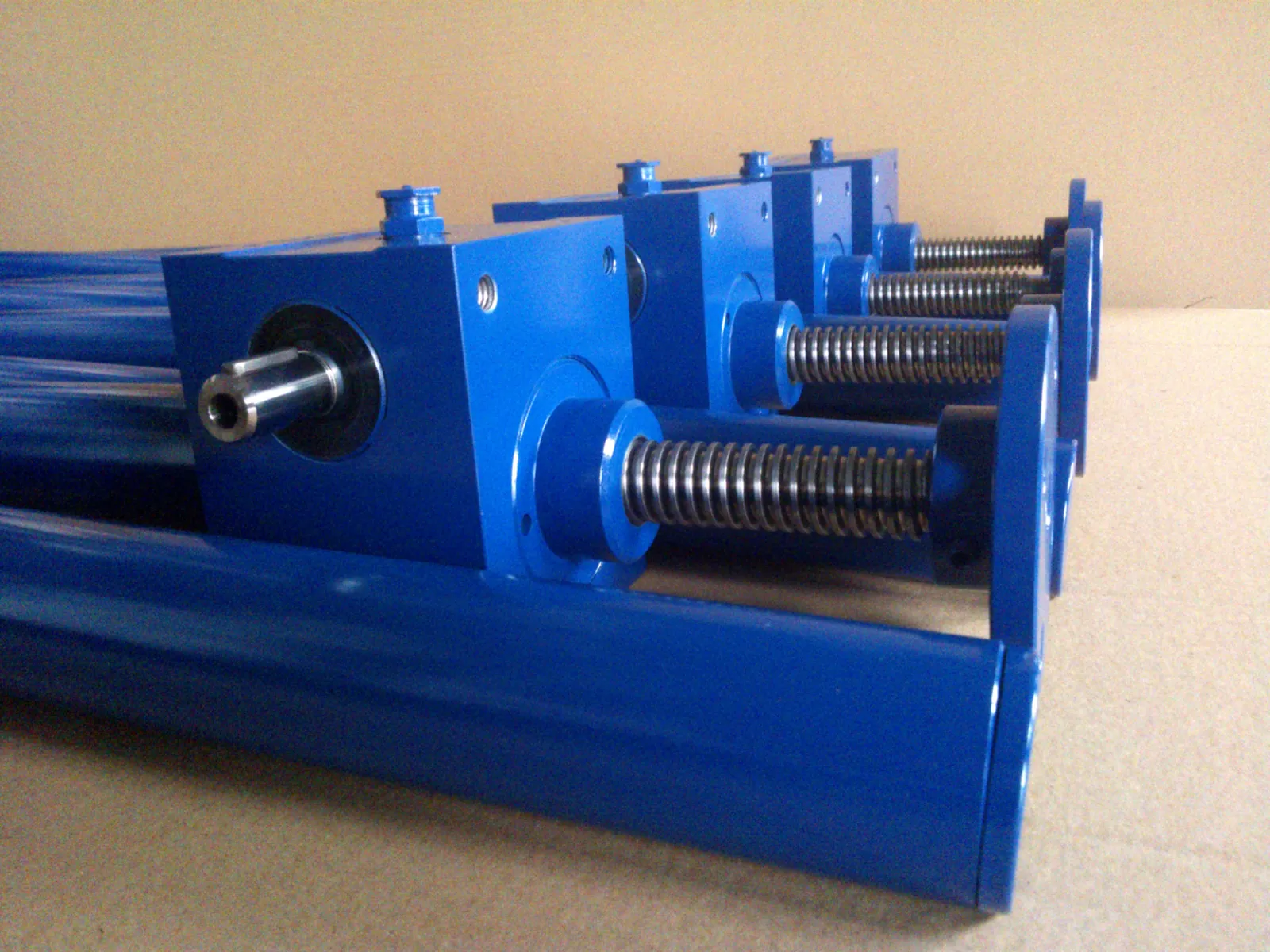
Screw jack or hydraulic cylinder?
A hydraulic cylinder is fast, compact and hard to beat at very high forces. But it is a strongman who travels with a whole service crew: a power pack with pump, a tank, valves, hoses – and oil that sooner or later seeps out somewhere. A screw jack makes do with an electric motor (or a crank) and a grease filling.
| Screw jack | Hydraulic cylinder | |
|---|---|---|
| Drive | electric motor or by hand | power pack, valves, hoses |
| Holding position | mechanically; larger sizes self-lock at rest, otherwise a brake | by valves; with leakage the load slowly creeps down |
| Fine positioning | 1 mm or 0.25 mm per input revolution | depends on valve control |
| Several points at once | linked by shafts, exactly in sync | flow dividers or closed-loop control |
| Speed | TMP up to 2,800 mm/min | high |
| Continuous duty | limited by duty cycle | good |
| Maintenance | lubricate the screw, check nut backlash | oil, filters, seals, hoses |
Choose a screw jack when the drive stands still most of the time and must hold its position precisely, when you need to lift at several points at once, or when you do not want hydraulic oil and its leaks in your plant.
Hydraulics win when you need very fast or very frequent motion, shock loads or extreme forces in a small space – and when there is already a power pack in the machine.
Need speed and precision? On request we supply screw jacks with ball screws – they are more efficient, run cooler and handle longer duty. How a screw jack works is explained on the page What is a screw jack.
Got a job for us? Let's get it moving.
Send us the type, a drawing or just a photo of the old gearbox nameplate. We will come back with a quotation – or with the questions that save both sides time.