
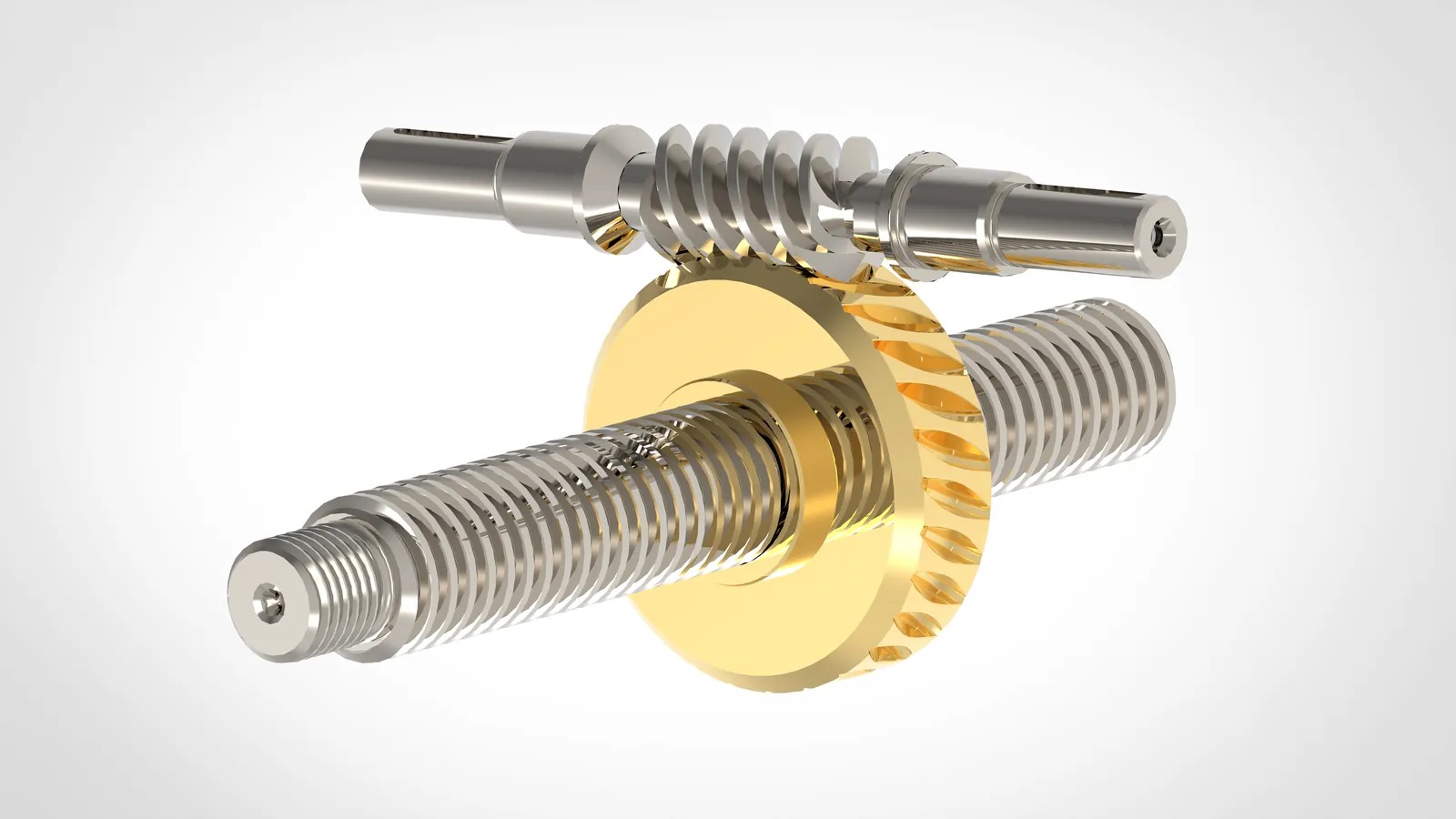
What is a screw jack and how does it work?
A screw jack turns the rotation of a motor or crank into linear motion – slowly, precisely and with great force. Inside there is a worm gear and a lead screw. Nothing more – and yet a single TMP 80 lifts up to 21 tonnes.
Worm, wheel, screw
The motor (or crank) turns the worm – a shaft with a thread. The worm meshes with a bronze worm wheel and slows it down considerably: TMP screw jacks have ratios from 4 : 1 to 40 : 1. The wheel then drives a trapezoidal lead screw.
What matters is what moves:
- translating screw – the wheel has an internal thread and pushes the screw out and in through the gearbox; the load sits at its end,
- rotating screw – the wheel is fixed to the screw and turns it; a nut travels along the screw and carries the load.
With the standard ratio SP one turn of the worm gives 1 mm of stroke, with the slow ratio L just 0.25 mm. So you can set the position very finely – simply count the revolutions.
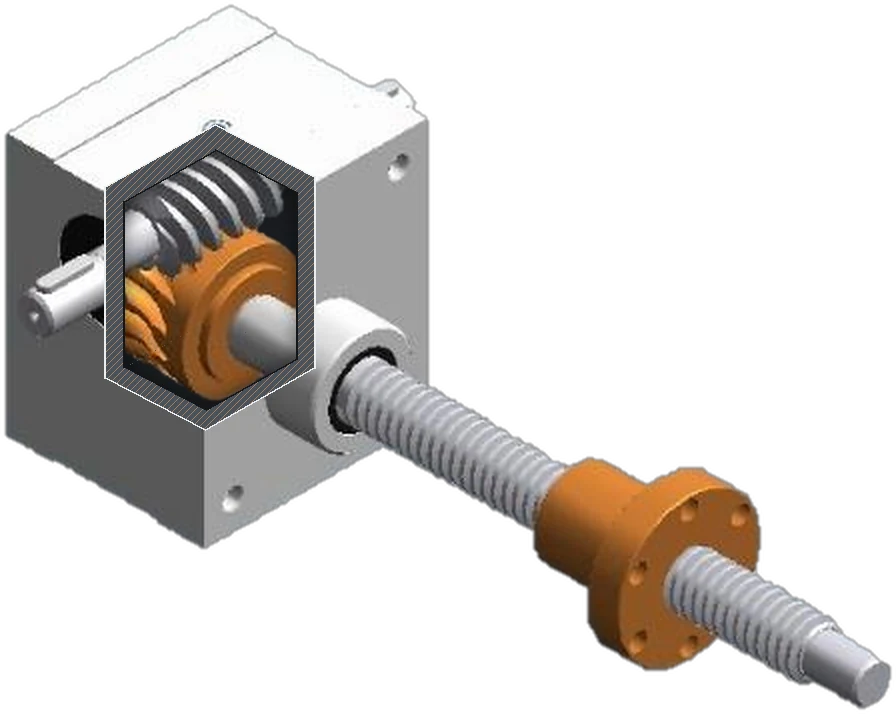
Why a screw jack
- High force from a small motor – gearing and screw multiply the torque; a TMP 80 lifts up to 210 kN (about 21 t).
- Precise positioning – 1 mm or 0.25 mm of stroke per input revolution, easy to control with sensors.
- Holds without power – the larger sizes are self-locking at rest; where vibration is a concern, a brake is added.
- Synchronised lifting – several jacks linked by shafts move exactly together, even under uneven load.
- Tension and compression, any position – vertical, horizontal or inclined.
- No hydraulics – no power pack, hoses or oil circuit; the jacks are grease-lubricated.
- By motor or by hand – electric motor, servo motor, or a handwheel or crank.
How to choose a screw jack – five steps
- Force per unit. Find the highest axial force on one jack – in tension and in compression. It decides the size: TMP 25 = 5 kN (0.5 t), TMP 32 = 10 kN (1 t), TMP 45 = 25 kN (2.5 t), TMP 63 = 50 kN (5 t), TMP 71 = 100 kN (10 t), TMP 80 = 210 kN (21 t).
- Type. If there is room below the jack for the extended screw, a translating screw (N, VS) will do. If not, choose a rotating screw with a travelling nut (RS).
- Stroke and speed. Lifting speed and stroke per revolution give the input speed – and that gives the motor. Ratio SP is faster, L finer and stronger.
- Duty cycle. Worm gear and trapezoidal screw heat up in long runs. Check that force and speed match the share of time the jack will be moving.
- Buckling and critical speed. Check a long screw under compression for buckling; with type RS, check the critical speed too.
The detailed procedure with tables is on the catalogue pages Screw jack calculation and Critical speed and buckling. Or send us load, stroke and speed – we will choose for you.
Where screw jacks are used
Lifting and work platforms, height adjustment of tables and conveyors, moving slides and doors, tilting chutes and flaps – wherever a load has to move precisely along a straight line. Our TMP units, for example, adjust the decks in car-carrier wagons and lift aircraft maintenance platforms. More in our references and under Lifting systems.
Screw jacks – frequently asked questions
Is a screw jack the same as a worm gear screw jack or a machine screw jack?
Yes, these are names for the same device. It is also called a mechanical actuator – in German Spindelhubgetriebe or Hubgetriebe, in Slovak zdvižná prevodovka.
What is the difference between a screw jack and a linear actuator?
A linear actuator today usually means a small 12 or 24 V electric drive – for windows, gates or furniture. A screw jack is an industrial drive for high forces – TMP units range from 5 to 210 kN (loads of roughly 0.5 to 21 t), have aluminium or cast-iron housings and can be linked into lifting systems.
Is a screw jack self-locking?
It depends on the gear ratio and the screw lead. In the TMP range, TMP 80 is self-locking at rest, TMP 32 to 71 conditionally and TMP 25 is not; standard units are not dynamically self-locking. Where the load must not drop even under vibration, a brake is fitted on the input.
How efficient is a screw jack?
With a trapezoidal screw it is low – 14 to 32 % for TMP, depending on size and ratio. That is the price of simplicity and self-locking. Where efficiency and speed matter, we supply ball screw versions on request.
Send us load, stroke and speed
We will choose the size, type and motor and send you a quote.